24 Aug 2026
Why Solar-Assisted Heat Pumps Are Britain's Next Big Energy Bet
Sun, Meet Compressor: Why Solar-Assisted Heat Pumps Are Britain's Next Big Energy Bet
Overview: Solar-assisted heat pumps — whether panels feeding a heat pump's electricity draw, or collectors directly warming its refrigerant — promise lower bills and faster decarbonisation for UK homes. This article examines the technology, the real 2026 numbers, and how it stacks up against gas boilers and standalone heat pumps.
What "Solar-Assisted" Actually Means
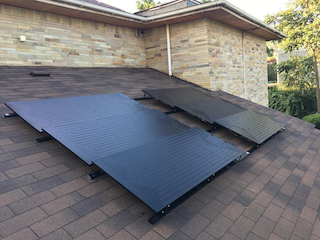
- PV-plus-heat-pump (SAHP, the common UK setup): solar panels generate electricity that powers a conventional air source heat pump (ASHP), either directly during daylight or via a battery for evening use.
- Direct-expansion solar-assisted heat pumps (DX-SAHP): a more specialist system where solar collectors act as the heat pump's evaporator, warming the refrigerant directly rather than generating electricity. This is well-proven in research literature — with laboratory coefficients of performance (COP) reported as high as 6.4 under strong solar irradiation — but remains rare in UK residential installs, being more common in hot-water applications in warmer climates.
The Numbers That Matter
- A typical air source heat pump delivers 3 to 4 units of heat per unit of electricity consumed, versus roughly 0.83–0.9 units of heat per unit of gas burned in a modern combi-boiler.
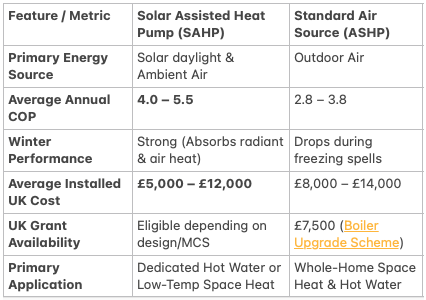
- Real-world monitored UK heat pumps average a Seasonal COP of around 3.87 across 252 systems tracked on heatpumpmonitor.org (January 2026), though MCS-certified installations more broadly average 2.8–3.5.
- A 5kWp solar array in central England generates roughly 950 kWh per kWp per year, with self-consumption rates of around 45% without a battery, rising to 75% with a 10kWh battery.
- Combining solar, a battery and a heat pump can save a typical three-bed home in the region of £1,200 a year versus a gas-and-grid baseline, according to UK Home Energy's 2026 modelling.
- Installed heat pump costs sit at roughly £8,000–£14,000 before grants (MCS Register, 2026), with solar panels adding £6,000–£9,000.
- The Boiler Upgrade Scheme (BUS) grant remains at £7,500 for air and ground source heat pumps in England and Wales (rising to £9,000 for homes switching from oil or LPG since July 2026), and 0% VAT applies to both heat pumps and solar panels until at least March 2027.
- On DESNZ's 2026 running-cost model, a gas boiler costs around £760 a year to run in a typical semi, against £1,450 for a standalone heat pump at SCOP 3.2 — a gap that solar self-generation is specifically designed to close.
SAHP Pros Versus Rival Systems
Versus a straight gas boiler
- Cuts a home's direct carbon emissions substantially — a heat pump at COP 3.0 produces roughly 50–67g CO₂/kWh of heat, against ~200g CO₂/kWh for gas, a gap that widens as the grid decarbonises.
- Removes exposure to gas price volatility, replacing it with self-generated electricity.
- Heat pumps typically last 20–25 years versus 12–15 for a boiler, avoiding at least one replacement cycle.
- Downside: significantly higher upfront cost even after the BUS grant — typically £1,700–£4,300 more than a like-for-like gas boiler swap.
Versus a standalone (non-solar) air source heat pump
- Solar meaningfully improves the economics: it can offset up to 1,000–1,700 kWh of a heat pump's annual electricity use directly from the roof, more with a battery.
- Improves resilience against rising electricity tariffs, since the household is buying less grid power at peak rates.
- Downside: UK solar generation peaks in summer while heating demand peaks in winter, so solar cannot cover most space-heating load — its main value is on hot water, spring/autumn heating and daytime running.
- Adds meaningful upfront capital (£6,000–£9,000 plus battery), extending payback periods to roughly a decade in most scenarios.
What to Watch Before Committing
- Sizing matters more than headline capacity. Installers generally recommend at least 5kWp of solar for a heat-pump home, with 6–8kWp better covering winter shortfalls.
- Tariff choice changes the maths substantially. Time-of-use tariffs designed around heat pumps (pre-heating in cheap windows, battery covering the evening peak) can be as influential on running costs as the solar array itself.
- Quotes vary widely. A 2025 Which? survey found a 40% spread between the cheapest and most expensive MCS-certified quotes for comparable installations, so multiple quotes are essential.
- Check installer accreditation. BUS grants require an MCS-certified installer, and only MCS-certified figures should be trusted for COP and cost claims.
Conclusion
Solar-assisted heat pumps aren't a silver bullet, but they meaningfully improve a heat pump's economics for UK homes willing to invest upfront. The technology works; the winter shortfall and installation costs remain real constraints. For most households, it's a compelling long-term solution.
Figures cited reflect 2026 UK pricing, grant levels and Ofgem price cap data, and may change as policy and energy prices evolve.
Sources and Further Reading
Boiler Upgrade Scheme — GOV.UK
MCS Certified — installer and performance data
heatpumpmonitor.org — real-world UK heat pump performance data
Energy Saving Trust — heat pump and solar cost guidance
Ofgem — Energy Price Cap
ScienceDirect — Direct-expansion solar-assisted heat pump research